
Self assessment scales
Assessment scales give healthcare staff a structured, objective foundation for evaluating a patient’s condition. They help ensure that important symptoms are not missed. Used regularly, they also make it easier to track changes and adjust care and treatment at the right time.
A default set of validated self-assessment scales are included in the platform. To be able to use them, an additional agreement with Doctrin is required.
Self-assessment scales can be integrated into other questionnaires, such as follow-up of a specific diagnosis.
The patient’s view:
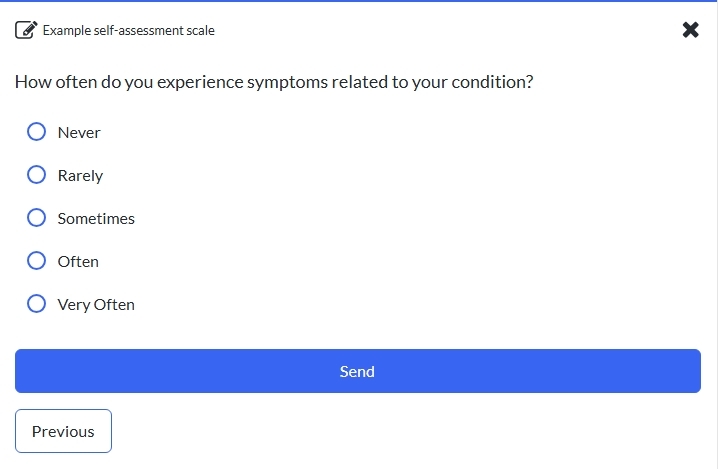
A self-assessment scale consists of a number of questions that the patient answers. Each response corresponds to a certain score. The patient only sees the questions and answer options, not the scores or their interpretation.
The healthcare staff’s view:
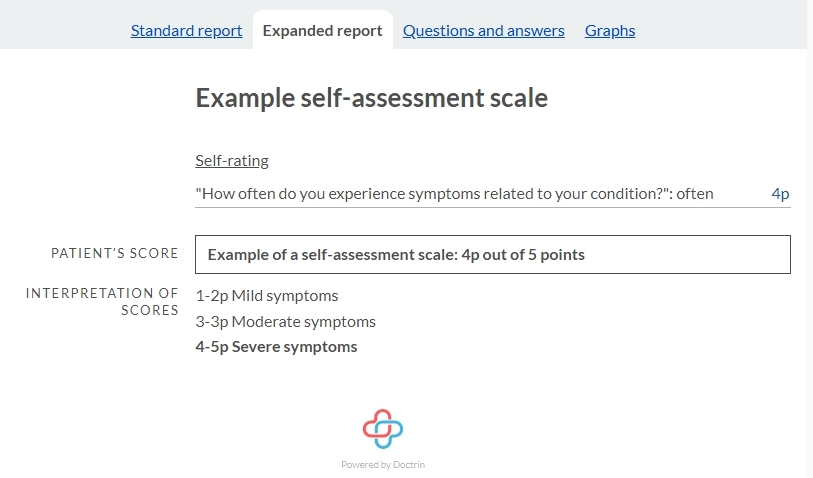
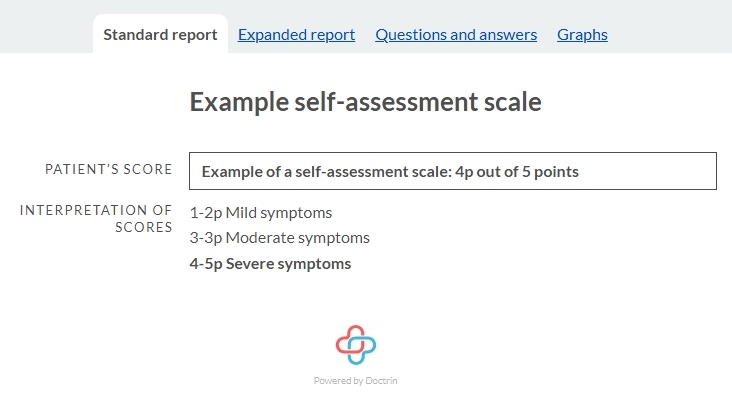
Scores are calculated automatically based on the patient’s responses. In the medical history report, healthcare staff can see the score for each question, the total score, and an interpretation of the score where applicable. Score ranges and thresholds are displayed with the lowest score at the top and the highest at the bottom. The interpretation matching the patient’s score is shown in bold.
Standard report and extended report
The standard report typically shows only the total score and any interpretation. The extended report also includes the patient’s responses to each individual question and the score for each one. The exception is responses to questions relating to suicidality or other sensitive information — these are generally shown in the standard report as well.
Graphs
If an assessment scale is completed on at least two occasions, a graph is displayed showing the current and previous scores (regardless of whether the questions were answered in different forms). This makes it possible to track changes over time. More about graphs (LINK TBD).
Example of medical report:
Updated on 2026-05-05